Chinese President visit

Prime Minister Muhammad Nawaz Sharif hand shake with Chinese President.

Democracy WINS - Pakistan WINS!

Wall street Journal news about democratic Pakistan

PCEC map

This is the original and only map of PCEC.

Mass Transit Bus Projects

Rawalpindi Metro Project

PM meets King Salman

Pakitan stands beside Saudia for its soverignity

Reduction in fares of public transport

Toll free helpline for compaints

Parliament Gallery

Group Photo| Speaker NA Sardar Ayaz Sadiq with Dr. Cyrill Nunn, Ambassador of Germany and Members of Pakistan-Germany Parliamentary Friendship Group

News reel

Followers

Showing posts with label Chashma nuclear. Show all posts

Wednesday, January 1, 2014

#RoshanPakistan | Nuclear Power Plant ahead of its schedule

Building of new N-plant to get dome tomorrow


ISLAMABAD: The containment building of the fourth reactor at the Chashma Nuclear Power Complex would get its ‘dome’ on Thursday, marking the completion of major civil works at the unit.
“The emplacement of the 180-tonne steel dome is a significant milestone in the installation of the reactor,” an official of the Pakistan Atomic Energy Commission (PAEC) said on Tuesday.
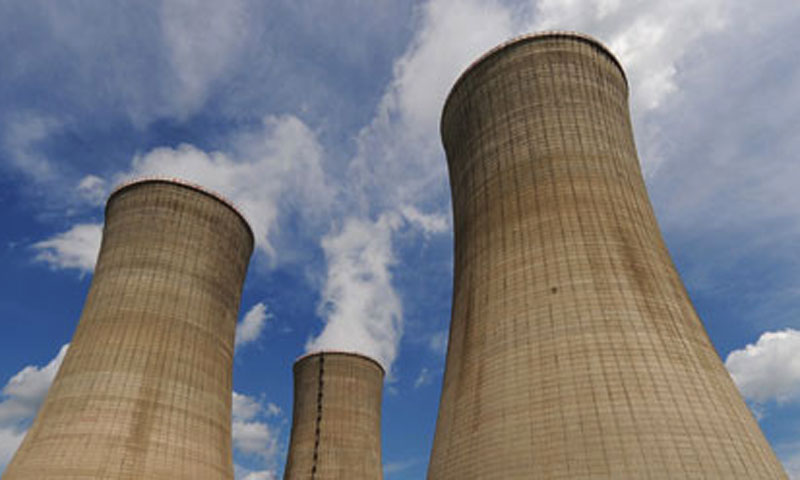
Chashma IV, as it is commonly known, is being built in collaboration with Chinese firms — China Zhongyuan Engineering (general contractor) and China Nuclear Industry Construction Company (installer). Shanghai Nuclear Engineering and Research Design Institute had provided the design for the reactor.
Two reactors are currently being installed at the Chashma Nuclear Power Complex — Chashma III and Chashma IV. Contracts for the two reactors were signed with the Chinese firms in 2009 and they are expected to begin commercial operations in 2016 and 2017 respectively.
Officials associated with the nuclear programme believe that the two reactors could be commissioned before schedule.
Chashma III got its dome in March.
Both Chashma III and IV are 340mw pressurised water reactors. Chashma I and II, also provided by China, were 300mw each.
The PAEC official explained that installation of reactor equipment at the site would continue after the capping (‘dome laying’) of Chashma IV.
The government has set a target of generating 40,000mw of electricity from nuclear sources by 2050.
The government says that access to cheap nuclear energy was vital for sustained growth.
“The cost assessment shows that the unit cost of electricity generation from the new nuclear projects will be below those of the other major sources in the country apart from hydro electricity, and comparable to coal (imported or local) — the environmental impact of burning coal notwithstanding,” another PAEC official said.
The ground-breaking ceremony of the country’s largest nuclear power plant (Kanupp-II and Kanupp-III) with a combined generation capacity of 2,200mw was performed in Karachi in November. The city has a pressurised heavy water reactor Kanupp-I, a 125mw facility.


Wednesday, August 8, 2012

Better Pakistan | Power Generation projects

Better Pakistan | Power Generation Projects (Part I)


Electrical power being an integral part of any country is a vital need for any good governance. The load forecasting and the establishment of new power projects are thus an important requirement for any rising economy. Recent power outages in our country have shown that the shortfall of the electricity is actually a mare failure of the previous governments who never tried to cope with the growing demand of electricity. The shortfall of electricity further enhanced by the economic policies of present federal govt. who has not yet started any major power generation project.

PMLN being the largest rightest party in Pakistan have always focused on poverty elevation using industrial revolution. This way country not only gets revenue but it also decreases the unemployment ratio. Since industrial revolution is proportional to the energy supply and demand therefore in the two tenures of PMLN we put our best to supply an uninterrupted power to the industrial as well as domestic users.

Without going into the details of what previous governments have done to increase the power production capacity, we as a party have enough to show that all major power projects have PMLN signatures on them. We are proud to stand in front of nation with projects that are serving this nation in the best possible way.

Our Milestones in Power Generation Arena 

As a pro people government during 1990-92 and 1997-99, PMLN was fully aware of the ill fated contracts signed by PPP government with Private independent power producers (PIPPs) during 1993-96. The contracts were signed at higher per unit rates compared to the affordable rates. The irony was not limited to the high tariff  but some companies were charging much higher than what they were charging in neighboring countries. This was an extra burden on GoP, therefore, PMLN govt lead by Mian Nawaz Sharif (1997-99) decided to negotiate with the IPPs to bring their tariff down. It was not easy as the companies were given guarantees from national as well as international organizations. In such effort 17 power companies agreed to bring their twerrif 30-50 % down of the contractual value. The Govt. also found irregularities in the contract of two companies and cancelled their contract thus saving an amount of PKR 15 Billion. A newspaper clip dated 5th of June 1998 is shown below for reference.


In order to create a competitive and liberal atmosphere for investment in power sector PMLN took following major steps.
  1. We did the restructuring and privatizing of the existing thermal power generation, the power transmission and distribution functions and assets of existing public sector utilities (WAPDA/KESC).  
  2. PMLN  created a fully autonomous regulatory authority, the National Electric Power Regulatory Authority (NEPRA). The NEPRA act was approved by parliament and signed into law in December 1997. The main aim of NEPRA was to create an autonomous, independent regulatory authority, which will be solely responsible for the power sector
  3. Other than this, PMLN while sensing the importance of power generation through IPPs, approved the power policy 1998 . The main points of this policy are given below.
  • The basis for selection of private power project will be minimum levelized tariff through International Competitive Bidding.
  • The process of selection will involve pre-qualification, issuance of a Request for Proposals (RFP), bidding and evaluation of bids against bid criteria clearly laid out in the RFP.
  • Detailed feasibility studies for every project will be prepared before bids are invited.
  • Hydel projects will be implemented on a Build-Own-Operate-Transfer (BOOT) basis; to be transferred to the province in which it is situated at the end of the concession period, and thermal projects on a Build-Own-Operate (BOO) basis.
  • The new Power Policy framework being proposed now is based on setting a tariff as a result of a competitive process through which private sector entrepreneurs will be invited to offer the lowest tariff per kWh for delivered energy.
  • The GOP will guarantee that the terms of executed agreements, including payment terms, are maintained during and after the transition to the private sector companies that result from the system restructuring described above. 

Major Power Projects 

The main power projects that were installed during two tenures of PMLN are following

CHASNUPP-1


The construction of Chashma Nuclear Power Plant Unit-1 (CHASNUPP-1), the second nuclear power plant in Pakistan, was started in 1992 with the help of People's Republic of China. It has an output of 325MW and has a life span of 40 years. (http://www.paec.gov.pk/chasnupp1/)

Ghazi Brotha HydroPower Project


The project is based on the utilization of the head available in the Indus River between Tarbela dam near Ghazi confluence with the Haro River and the Indus River near Barotha. It has  a peak power capacity of 1450MW. The feasibility of this Hydral power project was completed in 1992 during the first tenure of PMLN (http://www2.adb.org/Documents/PCRs/PAK/pcr-pak-26409.pdf).

Other than the above mentioned huge projects three new units each of 432 MW were installed at Tarbela that uplifted the installed capacity to a total of 3478 MW. The feasibility study of GolanGol hydro power project (106 MW) was also carried out during the tenure of PMLN. According to WAPDA feasibility study completed by HEPO/GTZ in 1997 which was later updated in 2005. 

IPPs Commissioned 


Power generation by IPPs also boasted during PMLN tenure that reflects the investment friendly policies of PMLN. The IPPs that were given contract / commissioned during PMLN tenures are given below (http://www.ppib.gov.pk/N_commissioned_ipps.htm  http://www.pepco.gov.pk/ipps.php )
  • Hub Power Project 1200MW agreement in 1992, commissioned on March 31, 1997 
  • Kohinoor Energy Power Project 126 MW commissioned on 20th June 1997
  • Gul Ahmed Power Project 125 MW commissioned on 3rd Nov, 1997
  • Tapal Energy power project 120 MW commissioned on 20th June 1997
  • AES lalpir Power Project 350 MW commissioned on 6th Nov, 1997
  • AES Pakgen Power Project 350 MW commissioned on 1st Feb,1998
  • Habibullah Coastal Power Project 126 MW commissioned on 11th Sept, 1999
  • Southern Electric Power 119 MW commissioned on 10th March, 1999
Three other IPPs that were worked by PMLN but later commissioned during the martial law of Gen. Musharraf . These are also listed below (http://www.pepco.gov.pk/ipps.php)
  • Fauji Kabirwala 151 MW commissioned on 21st Oct, 1999
  • Rousch Power 395 MW commissioned on 11th Dec, 1999
  • Saba Power 126 MW commissioned on 31st Dec, 1999
After the 18th amendment in the constitution , power generation is now a provincial matter. What are the efforts of PMLN lead Punjab govt. in this regard will be presented in the sequel of this blog post, and will be posted soon.

~Hadeed Ahmed Sher